.png)
 (956) 276-8819

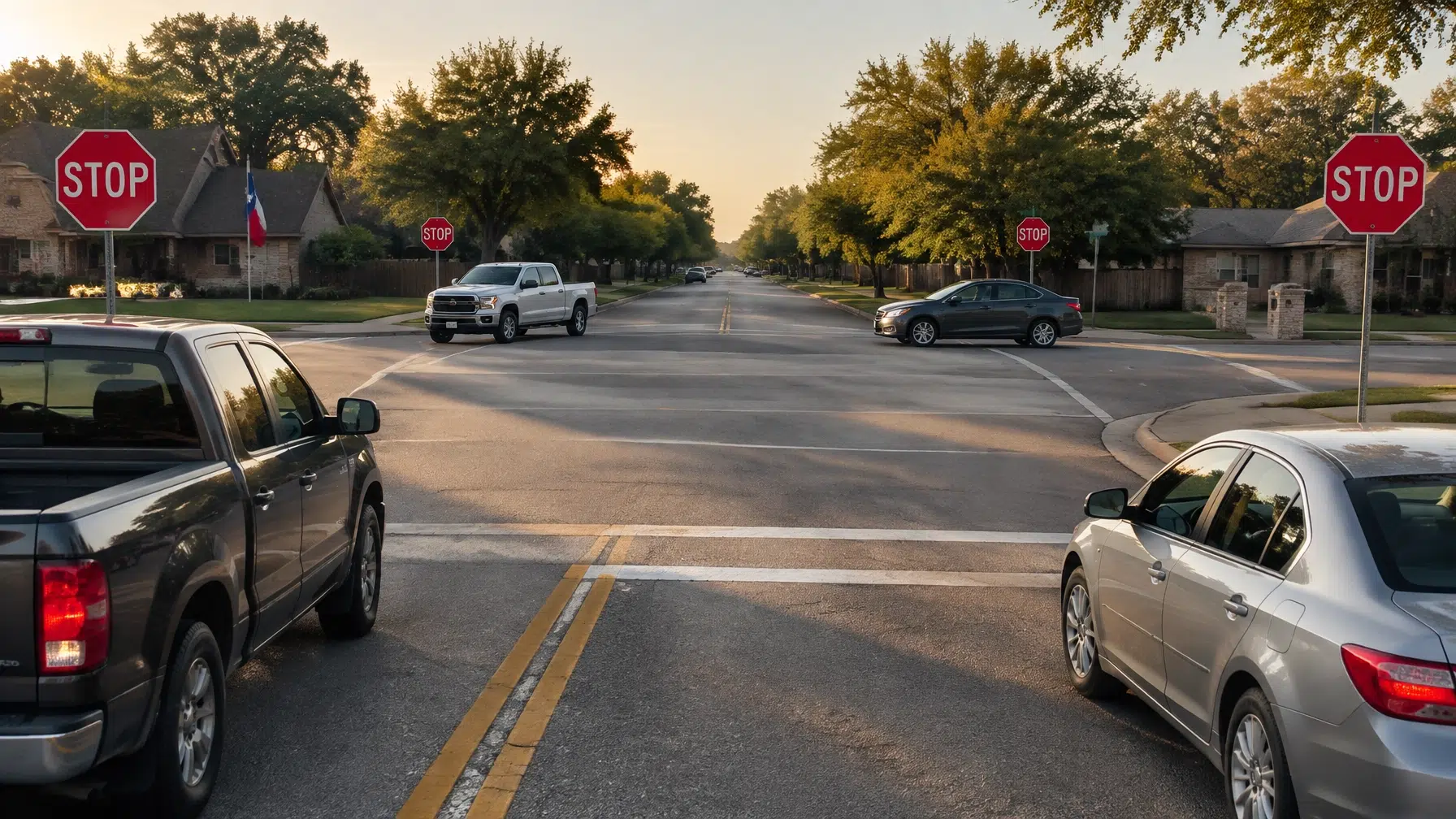
A four-way stop may appear simple, but determining who has the right of way can become difficult when two vehicles stop at approximately the same time. The issue becomes even more complicated when one driver claims to have arrived first, the other driver says the vehicles stopped simultaneously, or both drivers proceed after exchanging unclear hand signals.
Texas law requires drivers to stop, yield, and enter an intersection only when it is safe. A driver who fails to stop completely, enters too soon, turns improperly, or proceeds when another vehicle is already a hazard may be found liable for causing a crash.
This article explains how Texas law applies to four-way stops, including the rules governing simultaneous arrivals, left turns, pedestrians, evidence, and shared responsibility after a collision.
What Texas law requires at a stop sign
Under Texas Transportation Code § 544.010, a driver approaching a stop sign must stop at the proper location:
- At a clearly marked stop line;
- If there is no stop line, before entering the crosswalk; or
- If there is no stop line or crosswalk, at the nearest point where the driver can see approaching traffic on the intersecting roadway.
A complete stop requires the vehicle to come to a full cessation. Slowing down, tapping the brakes, or rolling through the stop sign is not enough.
After stopping, the driver must determine whether another vehicle, pedestrian, bicyclist, or other road user is already in the intersection or approaching closely enough to create a hazard. The driver may proceed only when entering the intersection can be done safely.
Texas Transportation Code § 545.153 specifically addresses vehicles entering stop-sign-controlled intersections. It provides that a driver approaching a stop sign must yield to a vehicle that has entered the intersection or is approaching so closely that it presents an immediate hazard.
That rule applies whether the intersection is in Edinburg, McAllen, Brownsville, San Antonio, or a smaller community in Hidalgo County.
Does the vehicle on the right automatically have the right of way?
Many Texas drivers have learned two common rules:
- The driver who stops first goes first.
- If two vehicles stop at the same time, the vehicle on the right goes first.
These rules are useful traffic conventions because they provide a predictable way for drivers to proceed. However, there is an important legal distinction.
The current Texas statutes governing stop-sign intersections do not expressly state that “the first vehicle to stop goes first.” They also do not contain a specific sentence stating that, at a four-way stop, the vehicle on the right always has priority when two vehicles stop at the same time.
The “vehicle on the right” rule is widely taught in driver education and commonly followed as a safety convention. It is also closely related to Texas’s right-of-way rule for certain uncontrolled intersections under § 545.151. But drivers should not assume that the right-hand rule automatically resolves every four-way-stop collision.
The controlling statutory duties remain:
- Stop completely.
- Yield to vehicles already in the intersection.
- Yield to vehicles approaching closely enough to be an immediate hazard.
- Enter only when the movement can be completed safely.
- Avoid interfering with other traffic.
This distinction matters in a personal injury case. A driver cannot simply argue, “I was on the right,” if that driver entered the intersection before the other vehicle had stopped, failed to observe a hazard, or proceeded in a way that caused a collision.
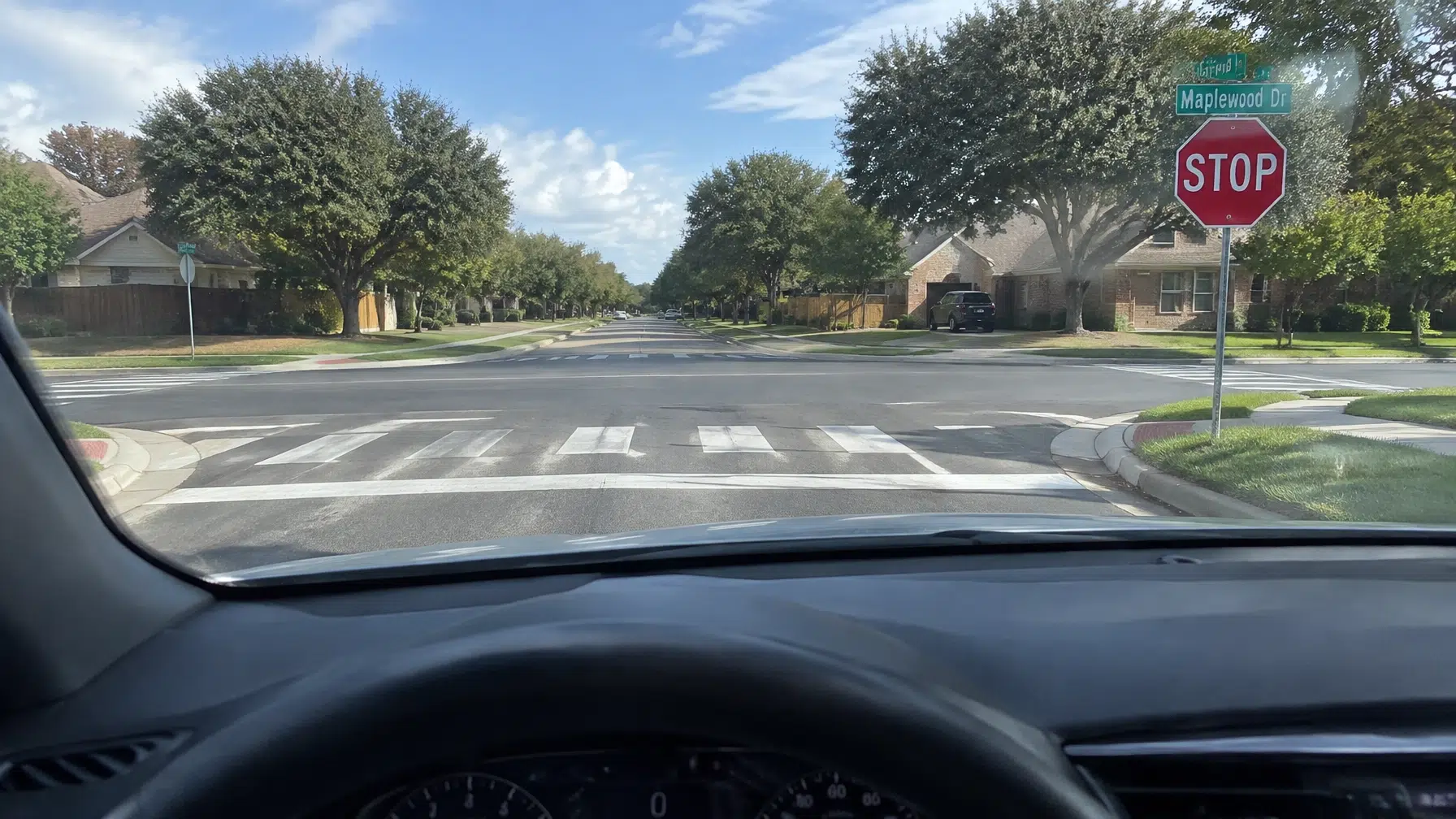
How “approximately the same time” is determined
Whether two vehicles stopped at approximately the same time is a fact-intensive question. It is not determined merely by where the vehicles came to rest after the collision.
An investigation may consider:
- When each vehicle first approached the stop sign;
- Whether one driver slowed earlier;
- Whether either vehicle made a complete stop;
- The distance between each vehicle and the stop line;
- Whether one vehicle entered the intersection before the other;
- Whether a driver accelerated after stopping;
- Whether a driver’s view was blocked by landscaping, parked cars, buildings, or other traffic; and
- Whether one vehicle was already close enough to create an immediate hazard.
A driver who stopped a fraction of a second earlier may not have a reliable legal advantage if the other driver was already entering the intersection. Likewise, a driver who technically stopped first may still be responsible if that driver proceeded without confirming that the intersection was clear.
The phrase “approximately the same time” does not create permission for both drivers to move at once. It requires caution and clear communication.
What if four drivers arrive at nearly the same time?
An all-way stop with four vehicles can create uncertainty. Each driver must stop and observe the intersection. Drivers should not rely solely on assumptions about who arrived first.
A practical approach is to:
- Stop completely.
- Identify any vehicle already moving through the intersection.
- Determine whether another vehicle is close enough to be a hazard.
- Communicate clearly before proceeding.
- Allow one vehicle to move at a time.
- Confirm that no pedestrian, bicyclist, or other vehicle is entering the crossing path.
If two drivers appear unsure, neither should accelerate. A driver may wait until the other vehicle clearly yields. If necessary, a driver can use a clear hand gesture, but should not wave another driver forward while simultaneously beginning to move.
Left-turn rules at a four-way stop
A driver turning left has an additional duty under Texas Transportation Code § 545.152. The driver must yield to a vehicle approaching from the opposite direction when that vehicle is in the intersection or close enough to be an immediate hazard.
This rule commonly applies when two drivers approach each other from opposite directions. One driver intends to continue straight, while the other intends to turn left. The left-turning driver generally must wait for the approaching vehicle to pass when the vehicles’ paths would conflict.
Other turning requirements also apply. Under § 545.101, a driver must make a right turn as closely as practicable to the right-hand curb or edge of the roadway and must make a left turn from the proper lane and into a lawful lane.
A driver who turns left across the path of another vehicle may be responsible even if both drivers stopped at about the same time.
The difference between a stop sign and a traffic signal
A four-way stop is controlled by stop signs. It is not governed by the same rules as a signalized intersection.
For context, Texas Transportation Code § 544.007 governs traffic-control signals. A driver facing a green light must still yield to vehicles lawfully in the intersection and to pedestrians in an adjacent crosswalk. A driver facing a red light must stop at the stop line or before the crosswalk and remain stopped until permitted to proceed.
That signalized-intersection framework is different from a four-way stop. Drivers should not assume that a prior dispute involving competing green-light claims will be analyzed in the same way as a collision involving stop signs.
Pedestrian rights at a four-way stop
Vehicles do not automatically take priority over pedestrians simply because the vehicle arrived first.
Texas Transportation Code Chapter 552 gives pedestrians important protections at crosswalks. Under § 552.003, a driver must stop and yield to a pedestrian crossing in a crosswalk when the pedestrian is on the half of the roadway where the vehicle is traveling or is approaching closely enough from the opposite half to be in danger.
Texas law also requires drivers to exercise due care to avoid colliding with pedestrians under § 552.008.
A driver approaching a four-way stop should scan all crosswalks before proceeding. This is especially important near schools, shopping centers, neighborhoods, and busy streets such as Bandera Road or local roads near Expressway 83.
Common four-way-stop crash types
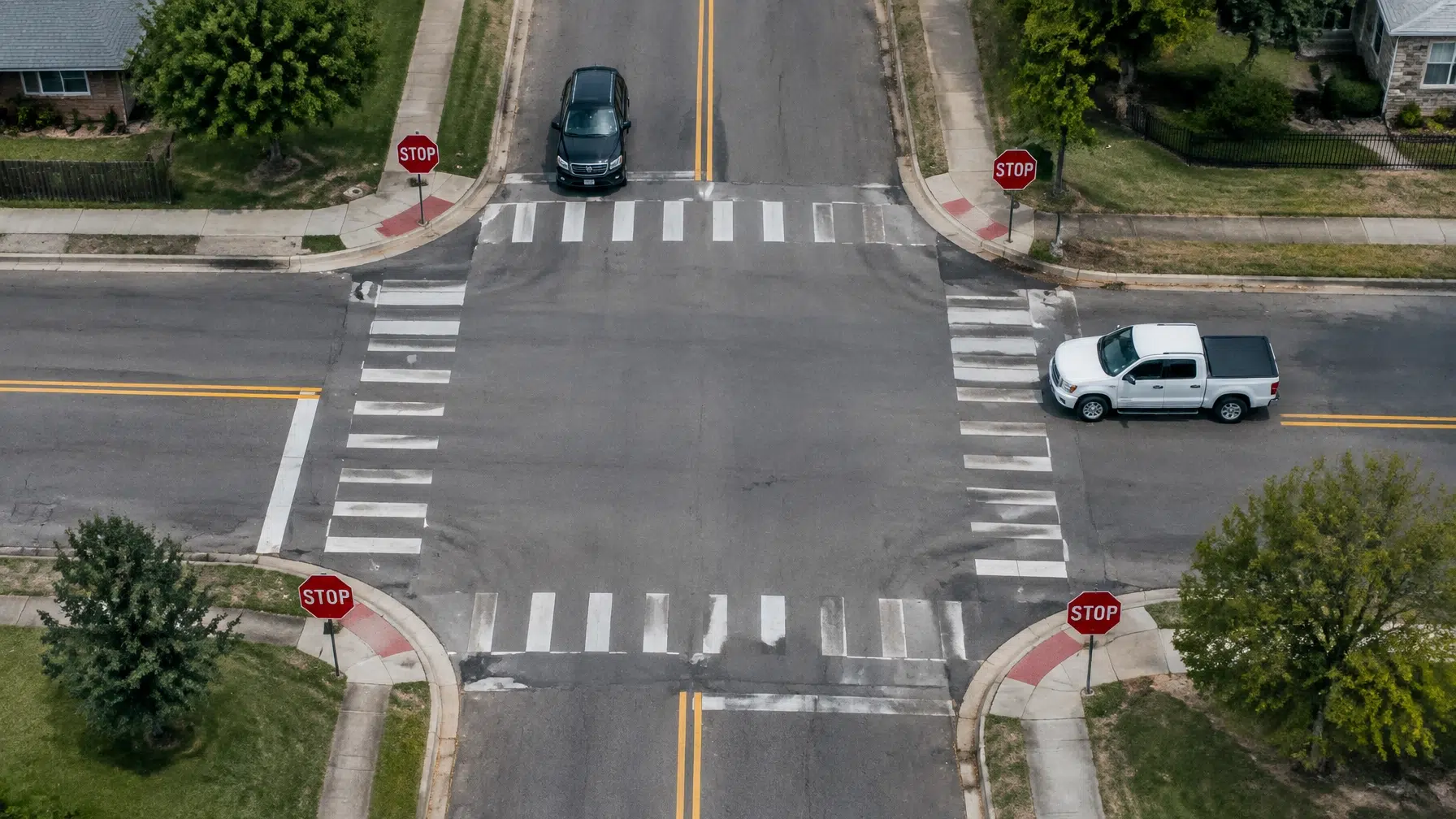
Four-way-stop collisions often produce serious injuries because vehicles enter from different directions. Common crash patterns include:
T-bone or side-impact collisions
A vehicle strikes the side of another vehicle after one driver enters the intersection without yielding. These crashes can cause head injuries, chest injuries, fractures, and abdominal trauma.
Right-hook crashes
A driver begins a right turn while another vehicle is moving through the intersection or attempting to pass through an adjacent lane. The turning vehicle may strike the other vehicle’s side or front corner.
Opposite-direction left-turn collisions
One driver turns left across the path of an oncoming vehicle. These crashes may occur when the left-turning driver incorrectly assumes the other vehicle will yield.
Rear-end collisions
A driver may stop suddenly because another vehicle enters the intersection or because the driver realizes the stop sign was missed. The following driver must maintain an assured clear distance and be prepared to stop safely.
When both drivers wave each other forward
Mutual yielding is a frequent cause of confusion. One driver waves the other forward. At the same moment, the other driver also waves and begins moving. Both vehicles then enter the intersection and collide.
Being polite does not eliminate a driver’s legal duty to operate safely. A hand gesture can be misunderstood, especially at night, in heavy traffic, or when tinted windows make it difficult to see the other driver.
If another driver waves you forward, make sure the other vehicle is actually stopped and is not moving into the same path. Do not rely on a gesture alone. If both drivers appear uncertain, wait until the other vehicle clearly yields.
Evidence used to determine responsibility
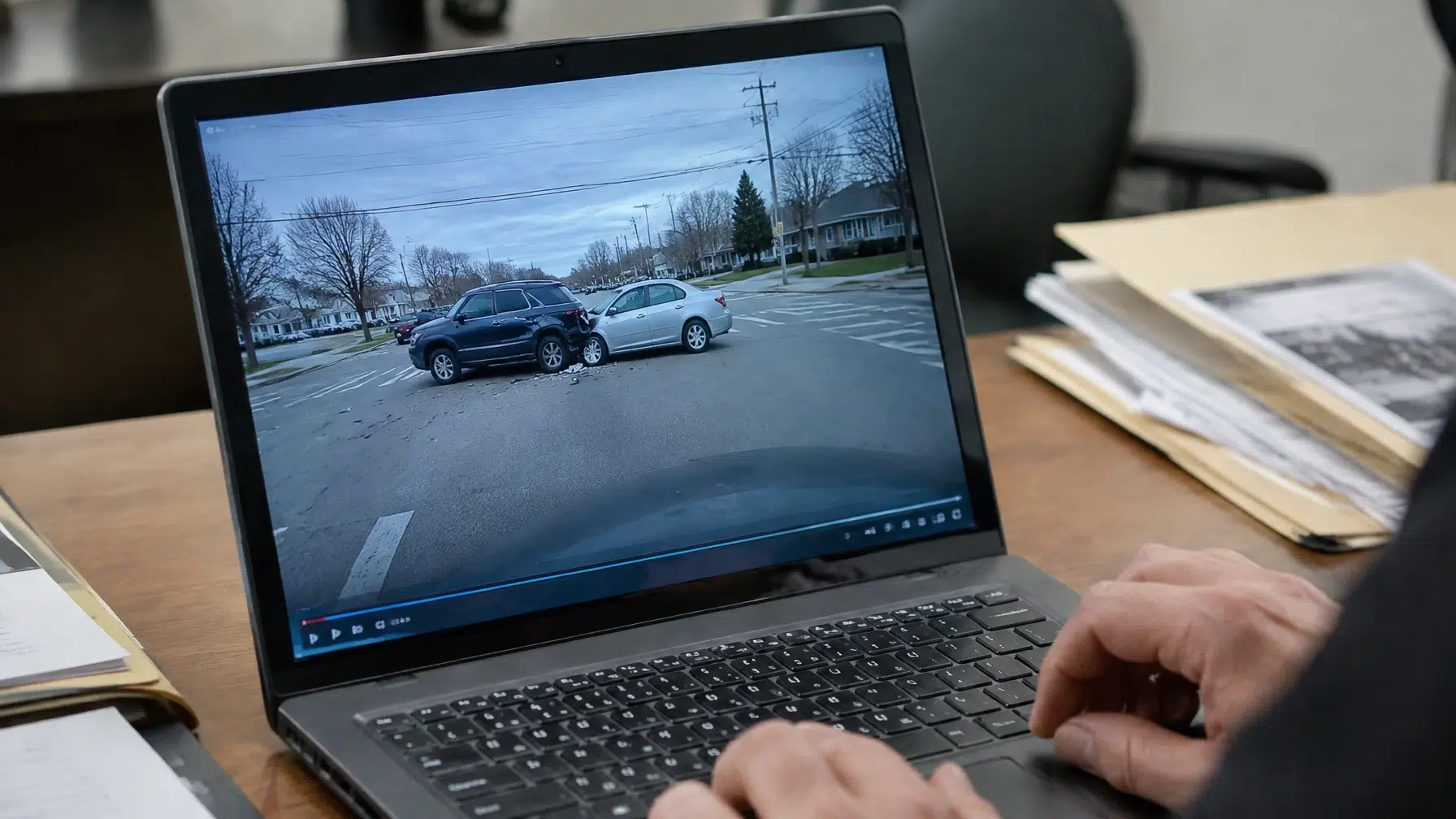
Evidence can establish who stopped first, whether a vehicle made a complete stop, and which driver entered the intersection first. Important evidence may include:
- Dashcam footage;
- Traffic-camera recordings;
- Video from nearby businesses or residences;
- Independent witness statements;
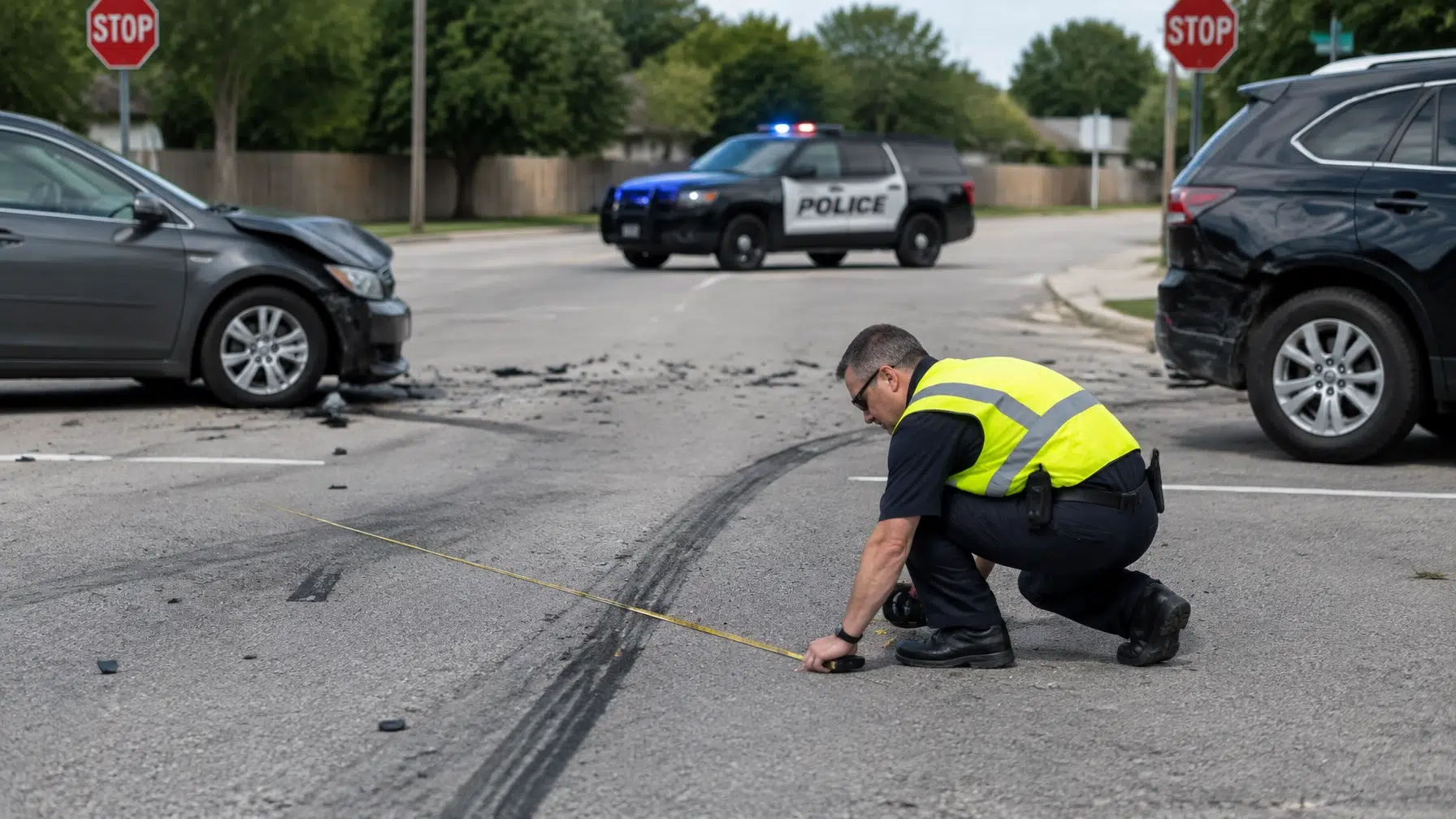
- Skid marks and tire marks;
- Vehicle damage patterns;
- Debris fields and point-of-impact evidence;
- Event data recorder information;
- Photographs of stop signs, stop lines, crosswalks, and sight lines; and
- The police crash report.
Video may show that a driver rolled through the stop sign or accelerated before the intersection was clear. Physical evidence may also show the direction of travel and the location of the impact.
How comparative negligence may affect compensation
Texas follows a modified comparative negligence system. Under Texas Civil Practice and Remedies Code § 33.001, a claimant may not recover damages if the claimant’s percentage of responsibility is greater than 50 percent.
If the claimant is 50 percent or less responsible, the damages are reduced according to that percentage. For example, if a jury determines that a driver suffered $100,000 in damages but was 20 percent responsible for the collision, the recovery may be reduced to $80,000.
In a four-way-stop case, the insurer may argue that both drivers were negligent. The insurer may claim that the injured driver failed to stop, entered too quickly, ignored the vehicle on the right, turned improperly, or proceeded after an unclear wave.
The actual allocation of responsibility depends on the evidence. A police citation may be important, but it does not automatically determine civil liability.
What to do after a four-way-stop crash
After a collision:
- Call 911 and request medical assistance if anyone is injured.
- Seek medical attention, even if symptoms appear minor.
- Photograph the vehicles, intersection, stop signs, stop lines, crosswalks, and sight obstructions.
- Obtain contact information from independent witnesses.
- Write down which direction each vehicle was traveling and who appeared to stop first.
- Avoid arguing about fault at the scene.
- Do not admit responsibility.
- Be cautious before giving a recorded statement to an insurance company.
- Preserve dashcam footage and vehicle data.
- Contact a Texas personal injury attorney before accepting a settlement.
Contact a Texas car accident attorney
A four-way-stop crash may appear straightforward, but disputes about timing, complete stops, right-of-way, left turns, pedestrians, and comparative negligence can significantly affect a personal injury claim.
The Law Office of Raul A. Guajardo, P.L.L.C. has more than 20 years of experience representing injured clients in Texas. We offer free consultations, work on a contingency-fee basis, and charge no fees unless you win. Our bilingual legal team serves clients in English and Spanish.
We represent injured people in the Rio Grande Valley, San Antonio, and surrounding communities. Contact one of our offices:
- Edinburg: 956-276-8819
- McAllen: 956-476-6055
- San Antonio: 956-318-3200
- Brownsville: 956-476-7074
Visit www.raulguajardo.com to request a consultation. This article provides general information and is not legal advice for a specific accident.